(Agile Cinema®)
Acting is living truthfully under imaginary circumstances – Sanford Meisner
From an office on the twenty-sixth floor of the US Bank Tower, Los Angeles appears through a series of horizontal striations embedded in the windows. The frosting divides the view into alternating bands of relative transparency and opacity, interrupting the apparent continuity of the city. Buildings, streets, and distant lights remain physically unchanged, yet their visual relationships are reorganized by a surface placed between the observer and the world. The effect recalls a fundamental operation of painting: the division of a continuous field through marks, intervals, and differences in material density. Unlike a conventional representation of the city, the window produces an image through the selective obstruction of what already exists. Its composition depends equally on the architectural surface, the position of the observer, and the illuminated landscape beyond it.

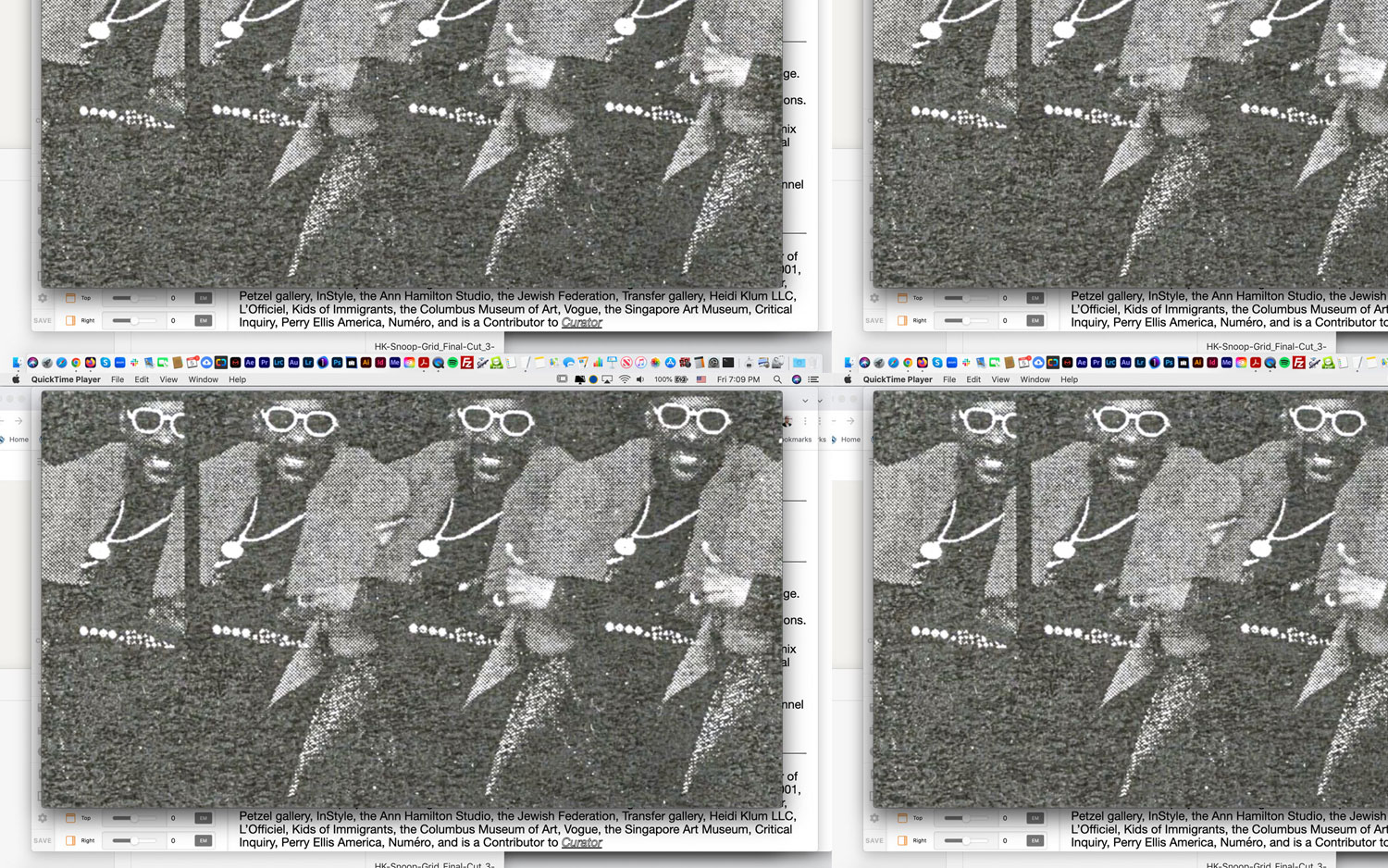
I filmed this view while occupying an office high above the city, a setting quite different from the former industrial buildings and improvised studios where I had previously spent time among artists and collectives. Those environments organized space around shared activity, provisional arrangements, and the practical demands of making things. The office tower established another relationship between the body and its surroundings, one structured through elevation, enclosure, and visual distance. Into this sequence I introduce footage of Snoop Dogg dancing and smoking at Milk Studio. His movements have an ease that resists the architectural regularity of the preceding image. The film alternates between these two conditions without attempting to explain one through the other. Their differences become especially perceptible through the cut: the fixed horizontal intervals of the window give way to a body whose gestures establish their own changing spatial relationships.

Painting can organize movement without depicting it. Repeated marks establish direction, interruptions produce intervals, and differences in density alter the apparent depth of a surface. The office window demonstrates these operations through an architectural material, while Snoop Dogg's dancing introduces movement that cannot be anticipated through a fixed compositional scheme. Yet the distinction is not simply between geometry and freedom. His gestures also depend on repetition, timing, and learned bodily conventions, just as the window's regular divisions produce unexpected relationships with the irregular city beyond them. The film brings these different structures into a single temporal composition. What interests me is the moment when a prescribed arrangement becomes capable of producing an unforeseen image. Painting begins with material decisions, but what becomes visible through them cannot always be determined in advance.