(Agile Cinema®)
Acting is living truthfully under imaginary circumstances – Sanford Meisner

A horizon appears to divide the world into two regions, yet its position depends on the location of the observer. In painting, this apparent boundary becomes a decision about the organization of space. A line, a change in color, or the interruption of a surface can establish relationships between foreground and distance without requiring the representation of a landscape. On a rooftop in the Los Angeles Garment District, Marike lies across a mirror reflecting the sky. The camera records her body against two incompatible spatial orientations: the horizontal surface supporting her and the apparent depth extending beneath her reflection. The resulting image raises a question familiar to painting: whether depth is something perceived in the world or constructed through the conditions of its representation.

The film moves to a forest in Big Bear at dusk, where diminishing light alters the visibility of trees, foliage, and atmospheric distance. I return to the account of the firmament in Genesis, where the separation of waters establishes a fundamental division within the created world. The passage offers a cosmological proposition rather than an optical explanation, yet it introduces a question that persists throughout the history of painting: how does an undifferentiated field acquire spatial organization? The forest provides no stable horizon. Its depth emerges through overlapping forms, changes in illumination, and the viewer's ability to distinguish one surface from another. As the light diminishes, these distinctions become less reliable without the physical arrangement of the landscape changing.

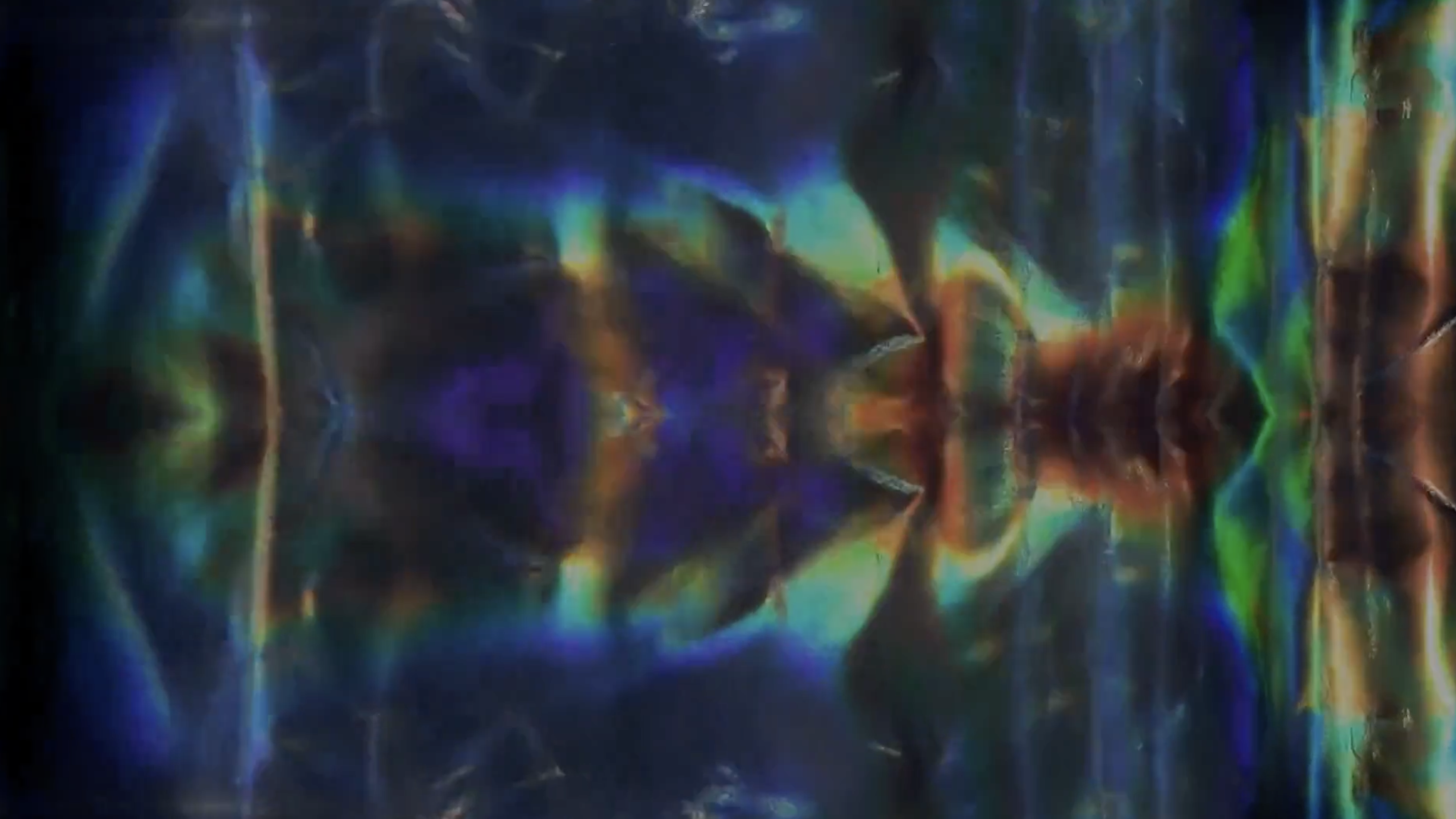
Returning to the rooftop, the film concentrates on fabric moving through sunlight. Folds create temporary boundaries between illuminated and shadowed surfaces, while kaleidoscopic repetition produces geometries that have no independent physical counterpart. The sequence brings together three different conditions of pictorial space: reflection, atmospheric depth, and the changing organization of a material surface. Painting operates through comparable decisions concerning color, orientation, scale, and the distribution of visual information. Yet the film also introduces duration, allowing spatial relationships to emerge and disappear as light and materials change. The horizon is no longer simply a line separating two regions. It becomes a question of how a division is established, perceived, and sustained.